Unknown's avatar

About Mike Vulanich

I'm an amateur triathlete and professional daylight maximizer, fueled by peanut butter and espresso. Here at mvtri.com I write about my training & racing as a competitive athlete, and the cool places around the world it's taken me.

Race Recap: Ironman 70.3 California (aka Oceanside aka Cramp City)

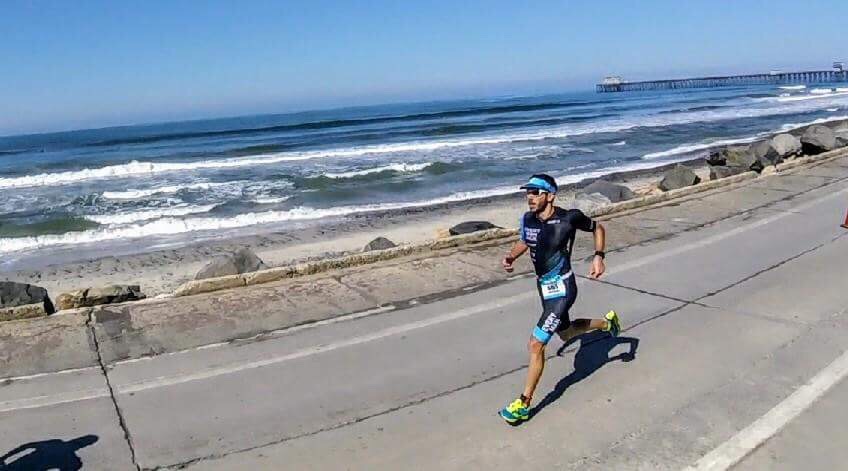
They don’t call it Oceanside for nothin. Thanks, Jen, for the photo!

I do well with consistency. I’m not sure if it’s nature or nurture, but let’s just say you can’t wake up at 4:30 for workouts without it. So in the spirit of that consistency that athletes hold so dear, I had a melt down in my first Ironman 70.3 of 2017, just like last year (though that was more of a freeze out).

Yes, Oceanside 70.3 didn’t go as planned. That might be putting it lightly. I was laying in someone’s front lawn putting ice down my pants at mile three of the run. It was a mess. But unlike last year’s bout with hypothermia, I was able to grit and bare my way to a finish. I even ran a few miles with Andy Potts! Keep reading to find out how I went from front lawn to finish line.

(Here’s my Instagram – press follow to see more pics of me doing exercise)

First thing’s first…

Let’s get something out of the way: I was not having the race of my life only to be foiled by cramps on the run. Even though it was the new rolling swim start*, I swam the same (slow) 31min I’ve swam for the last two years. The first half of the bike felt great! The second half I could not attack on the climbs as I would/can/planned.

Consequently I got off my bike further behind the competition and really needed a stellar run to salvage a result. Instead of panicking, that’s exactly what I planned to do.


Some of these splits are not like the others…zapped by massive leg cramps.


Cramps…what’s the big deal anyway?

A fun fact about me is that I’ve never cramped in a race before. I mean, I’ve “been crampy” before, pressing my stomach up into my ribs while running to get rid of side stitches. But I’m not sure I ever understood how cramps could be so debilitating.

Oh, I get it now…

After feeling my way through the first two miles I started to turn up the intensity, only to feel my lower back tighten. I stopped at the aid station just before mile 3 to loosen it up and both abductors (inner thighs) went off like car alarms, sending me to the ground.

The volunteers at aid station 3 were great, bringing me bananas, pretzels, oranges, water and Gatorade (which I politely declined**). They brought ice, which I put down my pants and on my core. I rubbed the cramps, I stretched, I prayed. I did it all.

If you’ll recall, I didn’t have a second to spare on this run, so as this continued, I realized my race goals were donezo and for a second I thought about quitting. But that second came and went, and my new goal was to finish. Not for a podium spot, but for the volunteers who were rushing around to help me, the spectators who cheered when I stood up, for the team name EVERY MAN JACK plastered all over me, and finally for me – to leave the race stronger, wiser, and sure that I’m not a pansy.

Getting up, falling, and getting up again

As I shuffled away from the aid station thinking about how much ten miles was “gonna suuuuck,” Andy Potts came running by on his way to the finish. Of course the natural thought for anyone who just writhing on the ground would be to run with an Olympian and Ironman Champion, so that’s what I did. I could tell Andy was perhaps having an off day, so in a way we were helping each other out; it’s amazing how much better you can feel being pushed by someone vs. suffering solo, something visible in mile splits 4 and 5 above.

As Andy peeled off to finish, I turned up the hill for lap two and had there not been a railing lining the course, this would have been me:

Image result for faking dead punt gif

The abductors blew out for good this time and I came to a halt, grabbing the railing, and inching forward. A spectator told me I needed to walk or it would get worse, so that’s what I did. Then I began to jog. Then run. The objective for the rest of the run was to run just beneath the point of “cramp explosion,” which I was able to do while slightly building mile by mile.

As I crossed the finish, turned to give the crowd an applause; they spent their free Saturday morning standing in the sun willing a crampy gimp to the finish. Respect.

So what was it that caused the cramps?

I really wish I knew. As athletes we love to point to that “one thing” and say, “Aha! I will fix that and move forward!” But the reality is that I have a handful of theories ranging from fitness, to equipment, to health, to nutrition that I will discuss with my coach, Matt Dixon and the purplepatch crew. Having a coach and/or trusted, knowledgeable sounding board is really important to learn from situations like this and I’m fortunate to be surrounded by smart folks to get it fixed before Santa Rosa.

Thank you

Thanks to all my friends and family, teammates and sponsors who showed their support! It goes an especially long way on days like this. See you at Santa Rosa!

___________________________________________

* Ironman installed a new “rolling start” to the swim, which was a self seeded time trial start. This was great for the faster athletes to get out in the front of the race and while I wasn’t able to capitalize on it in the water, made the rest of the race much more enjoyable. I hope they adopt this moving forward!

** I cannot drink Gatorade, or other sport drinks, especially during intense efforts. I’ve thrown up while cycling and running after drinking it (Muncie), my stomach just can’t handle all of the sugar and food dyes. Sometimes it makes sense not to make a bad situation worse.
2016: Year in Review

Some would say 2016 was…rough. I mean, for all intents and purposes, it could legitimately be the script of a compelling horror flick. This conflicts me. Because my year was prettay…prettay…prettay good. And I’m not just talking about race results (though those never hurt). I grew this year as an athlete, as a person and as a frequent flyer. The Cavs broke Cleveland’s 52yr drought in the best Game 7 of all time — and I was THERE. I drove Porsches in Atlanta, rode bikes in Taiwan and jumped off cliffs with the girl I love in Hawaii. I was on the cover of a fricking magazine with my teammates! What world is this!?

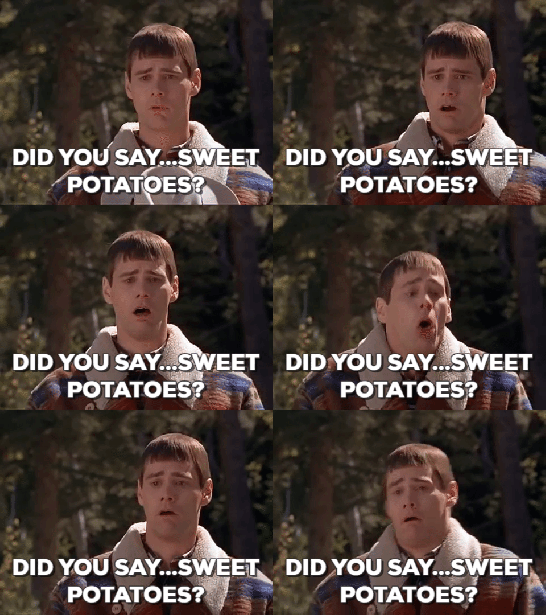
Don’t get me wrong, I’m still swimming 31min in a Half Ironman, the Cleveland Indians lost a Game 7 — and I was THERE, and I learned that I am allergic to my beloved sweet potatoes.

sweet potatoes gif.gif

Yes, there is plenty to improve upon in 2017. And as they say, if you measure it, you can improve it. So in the spirit of my race reporting this year – which featured super scientific charts – I’ve charted out the year in review. Read along for perspective of how it all came together and perhaps take tip/trick/or both with you to go.

2016-mileage

At face value, annual distances are pretty impressive. But compared to most competitive athletes, this weekly breakdown is pretty light. This is a product of fitting in what I can before and after long work days. Thankfully purplepatch’s philosophy is centered around building training into the available weekly hours of your life, not the other way around. This chart is a true example of quality, not quantity. Still, the swimming needs to be more, and will be in 2017.

Fun Fact – 10,312: miles traveled domestically for races this year, which is the equivalent to going to Tokyo and back.  

2016 Hours_ww.png

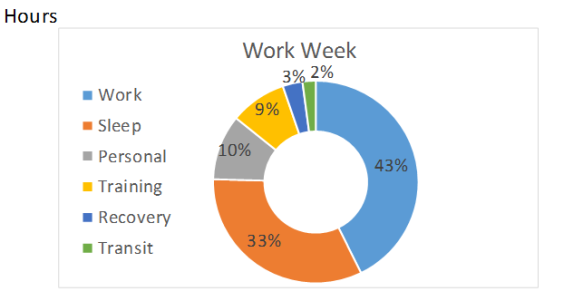
If the mileage above was the result of fitting what I can into a busy work week, here’s how the rest of a week shook out this year. One of my main goals was to sleep more and as you can see, a third of my year was spent in a dream (*tips hat to Westworld*). Sleeping is critical to recovery and in 2015 I was sick before almost every race — big training load, long work hours, personal life, no sleep. This year if I felt my 7.5-8 hours were in jeopardy, I’d scratch a session. By and large I’d say it worked. In 2017 I’ll continue to find sensible ways to optimize, growing that yellow 9% without throwing off the balance.

Fun Fact – 11: seasons of shows I completed this year with Dani and/or with my Normatec boots/lacrosse ball.   

2016-race-expenses

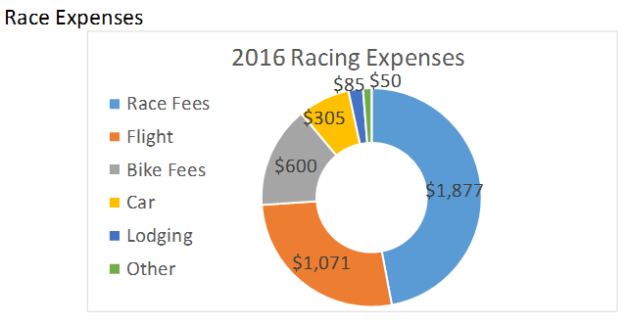
I raced six times this year across the country and it cost me about $4,000. No one said this sport is cheap. Could I have raced less or more locally? Yes. But my goal was to race regularly, at bigger races that pulled strong talent and this is how it shook out.

Fun Fact – $85: how much I spent total on lodging thanks to arranging homestays. Thank you Gina, Albrights, mom and dad and Sunns!

results-wordmark2016-results

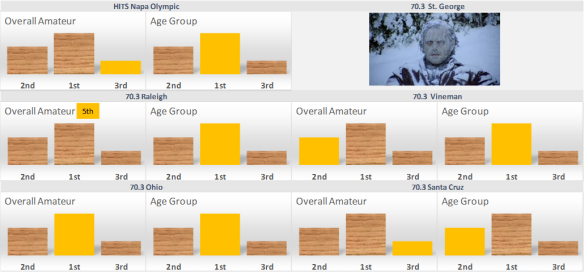
All of it added up to my first amateur win at a 70.3 event, a 2nd, two 3rds and a 5th. I won my age group at every race except for the final race of the year, Santa Cruz. I established a bike PR of 2:12 with strong bike run/combos putting me in the hunt of each race. Most importantly, I had a ton of fun seeing the country, being with teammates and pushing myself past my comfort zone.

Fun fact – learning from failure: my most viewed post of the year was: The Anatomy of a DNF, my recap of learning my limits after going hypothermic and dropping out of St. George. It’s not always about the end result, but the journey.

accolades-wordmark2016-accolades

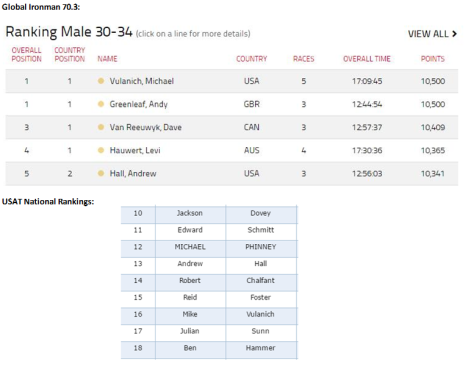
For my efforts, I ranked #1 in the world Ironman’s 70.3 age group point system. Pretty cool! So why the asterisk? Because no ranking system is perfect. Where you race, how big the race is, who is there, margin of victory, etc. all make up a complex system. And in the USAT rankings (i.e. all distances, all brands) I am 16th in the nation, let alone the world. In those rankings I’m 3/100s of a point ahead of teammate Julian Sun and 3/1000 of a point behind teammate Reid Foster. WHAT DOES IT ALL MEAN??? That I can be generally happy about trending higher year-over-year, while always trying to race the best guys in the world head to head. Hey, it’s actually pretty simple!

Fun fact – 7: of the 15 ranked ahead of me in USAT are on my team, Every Man Jack. 10 of the top 20 are ours. I don’t need to look past my own Strava feed for motivation! 

thank-you-wordmark

A successful year like this isn’t possible without a sturdy, well-developed support system. I am so grateful to the following folks for the guidance, support and in some cases sacrifice to help make this a reality:

Dani: You believe in me even when I have a hard time doing so myself. Your excitement and support mean everything.

Family & Friends: Since my first triathlon, my parents have traveled to at least a race a year. Nick, Nate, Joe, Kyleen, Joanne, Gina, Joey, Kerry – thanks for supporting this year. The Kesslers – the 614 connection is strong, thanks for the guidance and friendship. Everyone else who posts/texts/well-wishes – thank you!

Team Every Man Jack: The rankings above only tell half the story. I’ve developed lifetime friendships with these guys. Here’s to another fun and fast year, fellas.

Sponsors: It starts with being able to #cleanupnice after every workout with the awesome Every Man Jack products. EMJ and all of our sponsors support us with amazing products and opportunity that legitimately help us train better and race faster. See them all here.

***

And with that, goodbye 2016! Next up, some how, some way, improving in 2017. And I already have ideas of how to make it happened. So stay tuned!


Race Report: Double Down, Ohio + Santa Cruz

Image

It seems like ages ago that I crossed the finish line for the win twenty minutes from where I grew up at Ohio 70.3. That’s because, it was. The end of the season and beginning of post season have been wild, with six of the past eight weekends involving travel. And while I’d love to say that I’ve been sitting on these incredibly dynamic race stories, waiting to share them with the world, I’m here to tell you that’s just not the case. 

For all intents and purposes, these races were very similar and fairly vanilla in how the played out: a slower swim, followed by a faster bike and run led to an overall win at Ohio and a 3rd Amateur in Santa Cruz. But what I realized is these are the kind of races that are all about repeatable execution. In place of my standard Race Report format, I give a quick hit on the race phases and how I prepared similarly for both races. My hope is that triathletes from first timers to AWA frequent flyers will find a helpful nugget or two below. 

Eating for a late wave: A lot of race reports go into detail of what was eaten for breakfast. I think (and hope) most of the time this is because the author is writing the race report for their own record as much as they are for others. I’m not going to go into the details of my breakfast (ok, leftover white rice, almond butter and bananaIcouldn’thelpmyself), but what I’ve tried to master is “the late wave.” At every race this year except for Vineman my wave went off about an hour after the race started. Whether you’re first from the gun or a later wave, it’s important to dial in the timing of your eating. This can come from trial and error at races, and lord knows I’ve tried and erred, but it is also good to pick a few big training weekends to practice what you eat and when you eat it. If our wave is at 8:00, I’ll eat at 5:00, sip on a bottle with a hydration tab (GU is my fav) and top off with some bites of a bar 7:00 before our gun. Then at 7:45 I’ll have either a caffeinated gel or half a Red Bull. It’s important not to over eat, but this combination of my personal preference and purplepatch’s philosophy works for me to keep the engine fueled for a later start.

– Swimming with the right goggles: I swam in a way that felt just fine at both races, but came out behind, again. This isn’t new, but there were slight sighting issues at each: Ohio had blinding sun and Santa Cruz was foggy with a big distance at the turn buoys around the pier. Luckily I chose the right goggles for each — for Ohio I used mirrored amber lenses to ward off the sun while in SC’s fog I opted for the clear orange lenses for better visibility and color enhancement. My goggles of choice are the Roka R1 goggles because their ergonomic design makes sighting feel like looking through a windshield and they’re offered in a variety of lenses. It’s important to come to race with a pair of mirrored and a clear pair to be ready for either condition above. I had real trouble seeing buoys at each race, but would have had to stop and squint had I not brought the right pair.

– Handling the bike: The bike legs at each race were technical, but for different reasons. Ohio because there were 37 turns over the course of 56 miles. Santa Cruz because of rough roads and the subtlety of mastering big rolling terrain. Each because as late wave races, there was a ton of athlete traffic. In both races I had a solid bike split, and while that was partly because I was able to put my head down and ride hard, that only goes so far in both of these examples. In training I really focus on lines taken on descents and turns, being cognizant of my weight distribution, when to continue pedaling and when to tuck. I’m also obsessive about my gearing and being on the right cadence. Lastly, I embrace road bike group rides in the offseason, because I love it, but also to keep my edge sharp around unpredictable athlete traffic in races. This offseason I’ll be mountain biking to get even further out of my comfort zone and establish better handling. It sounds so obvious, but I know being a good bike handler earned me time in these races.

– Hydrate on the bike to setup the run: Ohio was hot and humid and at Santa Cruz I wore a vest, socks and toe covers on the bike as it was just over 50 degrees. The principle of nailing hydration on the bike to set up a good run is pretty well known throughout the tri world, and it’s definitely something purplepatch preaches. But it’s important to know that not all races are equal. And while my needs were very different for both races, my system was the same: A serving of hydration mix up front in my Torpedo (bottle/straw), and a concentrated bottle of hydration mix behind my saddle. At Ohio I shot for two bottles an hour and concentrated the rear bottle accordingly, squirting some into the Torpedo and mixing with water at aid stations. I started the Torpedo with pomegranate GU Hydration powder because of the slightly higher sodium, knowing my sweat rate would be higher, and concentrated the lemon-tea flavor in the back bottle for caffeine and flavor variation. At Santa Cruz, I only needed about a bottle an hour as it was very cool and I did not sweat nearly as much as Ohio, going only with lemon-tea powder throughout.

And while it’s great to have this system, it’s also important to be flexible. The rough roads at Santa Cruz ejected my rear bottle and I didn’t realize until it was too late, going almost miles without hydration. I do not usually drink the hydration beverage on the course as it makes me sick, so when I hit the aid station I filled up with water and nursed and extra GU with every sip. 

– Good socks matter: I used to get the worst blisters giant bloody holes in my feet during races. But whenever I trained in the same shoes (Saucony), I never had this issue. I decided not to go with any weird, new approaches on race day to prevent blisters and just convince myself the stabbing pain wasn’t there because I’m kind of crazy. But over time I learned that this was definitely from dumping water over my head on the run, something I wasn’t going to stop doing, especially in hot races. However this year, Sock Guy is a sponsor of ours. I had only trained in their socks and continued to race in what I was convinced were my “race socks.” But after Swiss cheese feet at Vineman I made the switch at Ohio — zero blisters. Only to be repeated at Santa Cruz. I’m not sure why the Sock Guy socks worked so well, but they really did and are my new “race socks.” 

– When you’re cranky on the run, you probably need calories: It happened in both runs, but at different times. Ohio it was as early as the second mile, and in Santa Cruz it was just after the 10K mark. My pace sagged a bit, the going was getting tough, and my mind went from positive to negative. We’ve all had those moments, but the key is learning how to get out of them. Matt Dixon told me recently on a Team EMJ discussion that usually when you go to that negative mental place, often it is because the fuel tank has hit the red bar before “E.” So in both races I took an extra few seconds at the aid station to really make sure I got my fill of the good stuff (in my case, Coke and/or Red Bull). And in both cases I went on to have pretty good runs with faster running at the end. 

– Embrace the finish: Both races had really cool finishes. Ohio’s was on the track at Ohio Weslyan University, a track I’d run on in high school. My family and dear friends were in the stands. Santa Cruz had the infamous beach finish and while it’s thankfully much shorter than when it was Big Kahuna, it’s still prefaced by a bombing downhill into town with tons of spectators. Dani and friends were in the crowd on the beach. In both cases, I was hurting trying to get every last second on that clock, but the feeling of finishing a big race, especially when it’s such a cool finish line, was not lost on me and I soaked it up and felt alive. 

So while neither race had “marquee” moments, each were more experience notches on the belt. Casual and competitive athletes alike can and should always be learning. Have race tidbits you picked up this year and are worth sharing? Leave them in the comments section below!

And in case you thought I was going to leave you without some #badracepics, fear not, I have plenty. Some are almost decent!

Ironman 70.3 Ohio:

Ironman 70.3 Santa Cruz:


And if you made it this far on mobile, I owe you a drink…